New Underground Eel Species Discovered in India
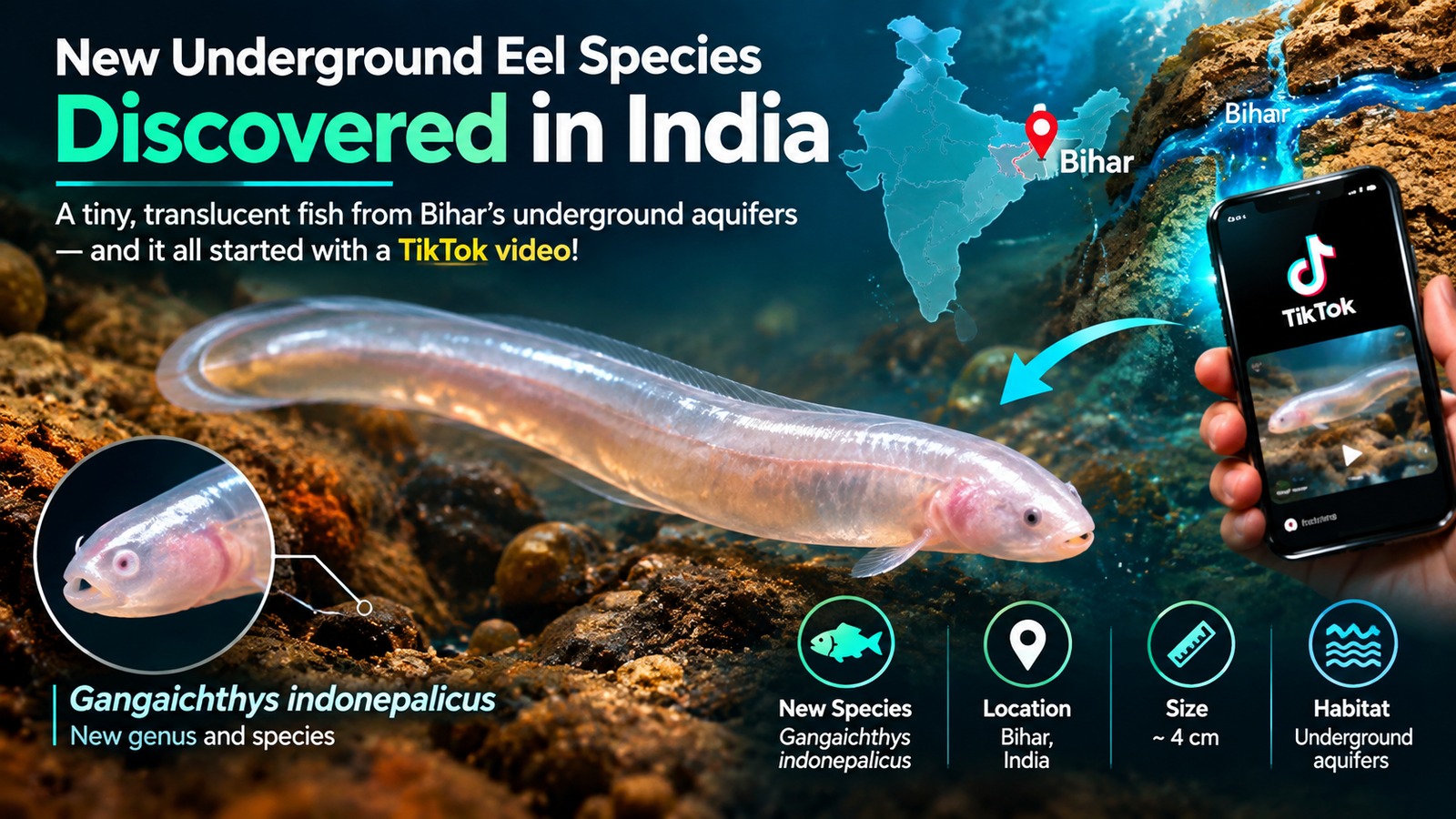
Scientists have identified an extraordinary new genus and species of tiny underground earthworm eel living in aquifers beneath Bihar’s Indo-Gangetic Plain — and the investigation began with an unusual video posted on social media.
🐠 A Remarkable Discovery Beneath Bihar
Researchers have described a previously unknown genus and species of miniature earthworm eel from groundwater beneath the Indo-Gangetic Plain in Bihar, northern India.
Named Gangaichthys indonepalicus, this tiny colourless fish belongs to the earthworm eel family Chaudhuriidae.
Most remarkably, it represents the first known stygobitic fish from the Gangetic Basin. Stygobitic animals are specialised organisms that live permanently in subterranean aquatic environments.
Gangaichthys indonepalicus
A miniature subterranean earthworm eel discovered in alluvial aquifers of the Indo-Gangetic Plain.
🔎 From Viral Video to New Species
📱 Video Spotted
Researchers noticed an unusual underground fish appearing in a social-media video.
📍 Search in Bihar
Scientists investigated handpumps and borewells in the region.
🚰 Fish Recovered
Thousands of litres of groundwater were manually pumped to obtain specimens.
🧬 Species Confirmed
Anatomy, micro-CT imaging and genetic analysis confirmed a distinct genus.
🌑 Adapted to a World Without Sunlight
Gangaichthys indonepalicus possesses several characteristics associated with permanent life underground.
👁 Reduced Eyes
The eyes are strongly reduced and covered by skin, an adaptation suited to an environment where vision provides little advantage.
🤍 Translucent Body
The fish lacks normal pigmentation and has a pale, translucent appearance.
📏 Miniature Size
The newly described underground fish measures roughly four centimetres in length.
🦴 Unusual Anatomy
Researchers reported distinctive skeletal features, including an apparent absence of ribs.
🏞️ What Does the Name Mean?
The genus name Gangaichthys essentially means “fish of the Ganga”, recognising the Gangetic region where the animal was discovered.
The specific name indonepalicus reflects the species’ occurrence near the India–Nepal border.
💡 Why This Discovery Matters
- It is the first known stygobitic fish from the Gangetic Basin.
- It reveals previously undocumented biodiversity living beneath the Indo-Gangetic Plain.
- It demonstrates how difficult-to-access groundwater ecosystems can contain highly specialised vertebrates.
- The discovery highlights the potential value of citizen observations and social-media content in alerting scientists to unusual organisms.
- It may encourage further research into India’s largely unexplored subterranean biodiversity.
📲 Can Social Media Really Help Discover New Species?
A social-media video cannot by itself establish a new species. Formal taxonomic descriptions require physical specimens, detailed anatomical comparisons and, increasingly, genetic evidence.
But photographs and videos shared online can provide scientists with valuable clues. In this case, an unusual video helped researchers identify an organism worth investigating.
It is a fascinating example of how everyday observations, digital communication and traditional field biology can unexpectedly intersect.
📚 Scientific Study & Sources
The new species was formally described by Akshay Khandekar, Tejas Thackeray, Yilun He, Anil Mohapatra and Ishan Agarwal in the peer-reviewed journal ZooKeys.
Research title:
Gangaichthys indonepalicus, a new genus and species
of miniature stygobitic earthworm eel
(Synbranchiformes, Chaudhuriidae) from alluvial aquifers
in the Indo-Gangetic Plain, Bihar, northern India.
An Entire Hidden Ecosystem Beneath Our Feet
The discovery of Gangaichthys indonepalicus shows that remarkable biodiversity can survive in places humans rarely see. Beneath one of South Asia’s most populated landscapes, a tiny translucent fish had remained scientifically undocumented — until an unusual online video helped point researchers toward its underground world.