Introduction
Completing Class 12 is one of the most significant milestones in a student’s academic journey. It marks the beginning of a new chapter where every decision can influence future career opportunities, financial stability, and personal growth. While some students have a clear vision of their goals, many struggle to decide which course to pursue after completing their higher secondary education.
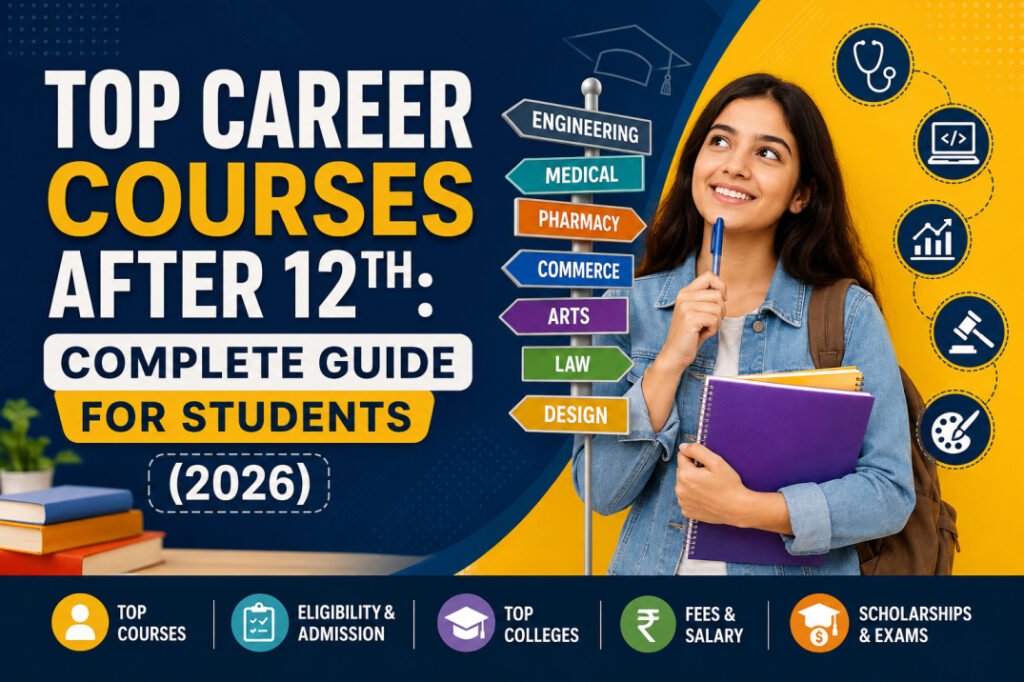
The education landscape in India has evolved dramatically over the last decade. Traditional career options such as Engineering, Medicine, and Pharmacy remain popular. Still, newer fields, including Artificial Intelligence, Data Science, Biotechnology, Cybersecurity, Digital Marketing, and Healthcare Management, are creating exciting opportunities for students.
According to industry reports, employers are increasingly looking for professionals with practical skills, interdisciplinary knowledge, and adaptability. Therefore, selecting the right course after 12th should not be based solely on trends or peer pressure. Instead, students should carefully evaluate their interests, strengths, career aspirations, and future job prospects.
Whether you are from the Science (PCM or PCB), Commerce, or Arts stream, choosing the right course requires thoughtful planning and research. In this comprehensive guide, we begin by focusing on Science students and explore some of the most rewarding career options available after Class 12 in 2026.
By the end of this article, you will understand:
- How to choose the best career path after 12th
- Important factors to evaluate before taking admission
- Career opportunities for Science students
- Eligibility criteria for major professional courses
- Scope, salary, and prospects of popular careers
Why Choosing the Right Course After 12th Matters
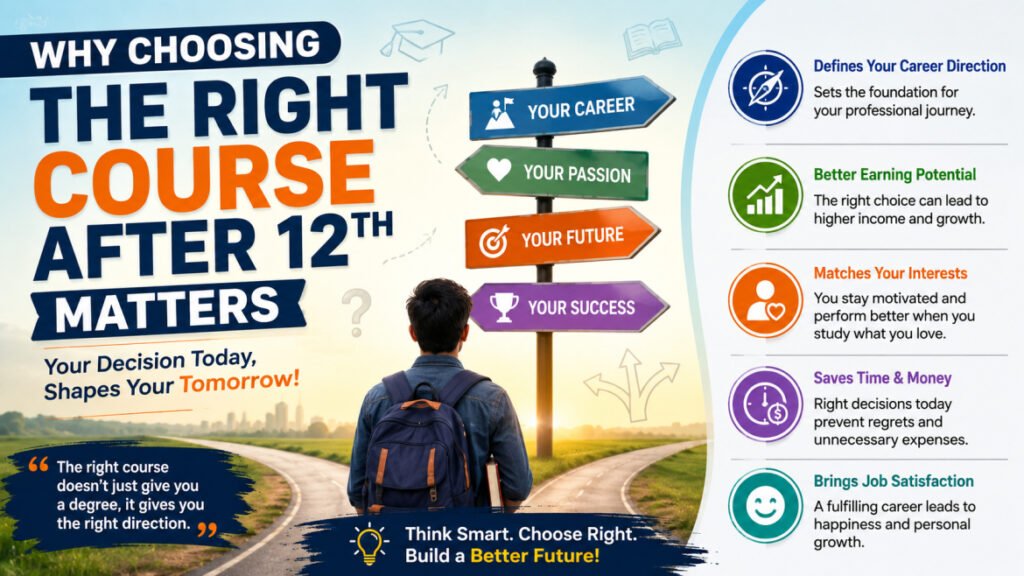
Selecting a course after Class 12 is much more than deciding what to study in college. It is the foundation of your professional career and can influence your earning potential, work-life balance, job satisfaction, and long-term growth.
1. It Defines Your Career Direction
The course you choose determines the industries and professions available to you in the future. For example:
- Engineering graduates can work in technology, manufacturing, software, civil infrastructure, and research.
- Pharmacy graduates can pursue careers in hospitals, pharmaceutical companies, research laboratories, regulatory affairs, quality assurance, and entrepreneurship.
- Medical graduates become doctors, surgeons, specialists, or researchers.
- Biotechnology graduates contribute to healthcare innovation, agriculture, and life sciences.
Although career changes are possible later in life, choosing an appropriate course from the beginning saves time, effort, and financial investment.
2. It Influences Future Income
Different professions offer varying salary packages depending on demand, specialization, skills, and experience.
For example:
| Course | Average Starting Salary |
|---|---|
| MBBS | ₹8–15 LPA |
| B.Tech (Top Institutes) | ₹5–18 LPA |
| B.Pharm | ₹3–8 LPA |
| Nursing | ₹3–7 LPA |
| Biotechnology | ₹4–8 LPA |
Higher education, certifications, and specialization can significantly increase earning potential over time.
3. It Matches Your Interests
Many students choose courses simply because their friends are joining them or because of family expectations. This often leads to dissatisfaction and poor academic performance.
Instead, ask yourself:
- What subjects do I enjoy?
- What activities excite me?
- Do I like solving technical problems?
- Am I interested in helping patients?
- Do I enjoy laboratory work?
- Am I comfortable with mathematics?
Honest answers can help identify the right academic path.
4. It Saves Time and Money
Changing courses after one or two years can be expensive and emotionally challenging. Tuition fees, hostel expenses, books, and entrance coaching require significant investment.
Proper career planning before admission minimizes the chances of switching programs later.
5. It Improves Job Satisfaction
A successful career is not only about salary but also about enjoying the work you do every day. Students who align their education with their interests generally perform better academically and professionally.
Factors to Consider Before Choosing a Course
Every student has unique strengths and aspirations. Before taking admission, carefully evaluate the following factors.
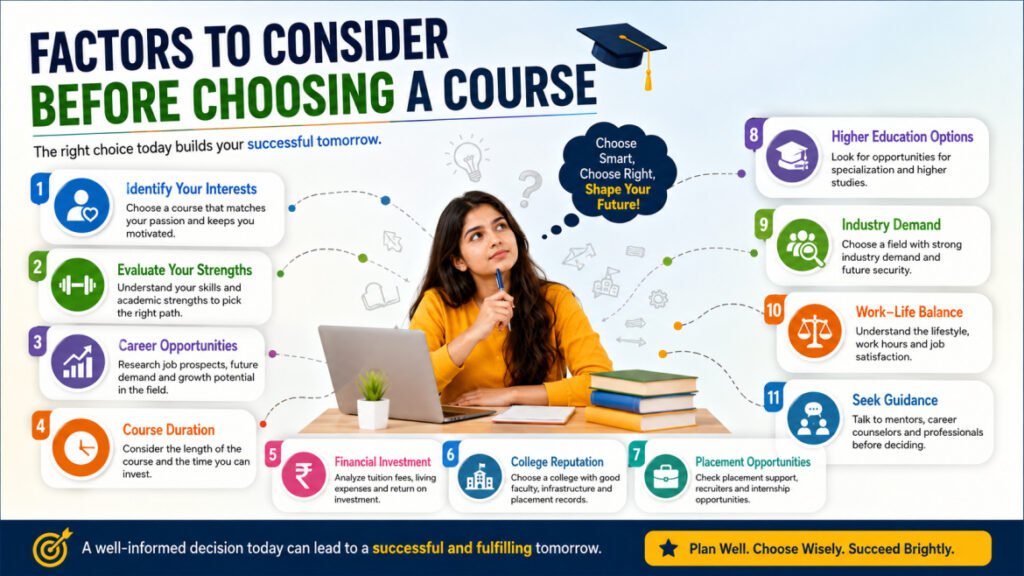
1. Identify Your Interests
Interest is the strongest predictor of long-term success.
Ask yourself:
- Which subjects do I enjoy studying?
- Which topics do I naturally explore online?
- What type of work excites me?
Students interested in Biology may excel in healthcare, while students passionate about Mathematics often enjoy Engineering or Computer Science.
2. Evaluate Your Strengths
Academic performance provides useful clues.
For example:
- Strong Mathematics → Engineering, Data Science, Architecture
- Strong Biology → Medicine, Pharmacy, Nursing, Biotechnology
- Strong Chemistry → Pharmaceutical Sciences, Chemical Engineering
Understanding your strengths helps narrow down suitable options.
3. Understand Career Scope
Research the demand for professionals in your chosen field.
Consider:
- Job availability
- Industry growth
- Global opportunities
- Government employment
- Private sector demand
- Research prospects
Emerging sectors such as AI, biotechnology, renewable energy, and pharmaceuticals are expected to witness strong growth over the coming years.
4. Consider Course Duration
Professional courses vary in duration.
| Course | Duration |
|---|---|
| B.Tech | 4 Years |
| MBBS | 5.5 Years |
| B.Pharm | 4 Years |
| D.Pharm | 2 Years |
| B.Sc Nursing | 4 Years |
| Biotechnology | 3–4 Years |
Students should consider how much time they are willing to invest before entering the workforce.
5. Evaluate Financial Investment
Higher education involves tuition fees, accommodation, books, transportation, and other expenses.
Compare:
- Government colleges
- Private universities
- Scholarships
- Education loans
- Return on investment (ROI)
Sometimes an affordable government institution offers excellent education and placements.
6. Research College Reputation
A good institution provides:
- Experienced faculty
- Modern laboratories
- Industry exposure
- Internship opportunities
- Placement support
- Research facilities
Always review accreditation, infrastructure, alumni success, and placement records before applying.
7. Placement Opportunities
Examine:
- Average salary package
- Placement percentage
- Recruiters
- Internship opportunities
Students should prioritize colleges with strong industry collaborations.
8. Future Education Opportunities
Consider whether the course offers opportunities for higher studies.
Examples include:
- M.Tech
- M.Pharm
- MD/MS
- MBA
- M.Sc
- Ph.D.
- International education
Higher qualifications often lead to better career growth.
9. Industry Demand
Technological advancements continuously reshape employment trends.
Future-ready industries include:
- Artificial Intelligence
- Pharmaceuticals
- Healthcare
- Biotechnology
- Robotics
- Renewable Energy
- Cybersecurity
- Data Science
Choosing a course aligned with future demand improves long-term employability.
10. Work-Life Balance
Some careers involve emergency duties, night shifts, travel, or fieldwork.
For example:
- Doctors often work long clinical hours.
- Nurses may work rotating shifts.
- Engineers may travel for projects.
- Researchers generally work in laboratories.
Understanding lifestyle expectations helps students make informed choices.
Career Options After 12th Science (PCM & PCB)
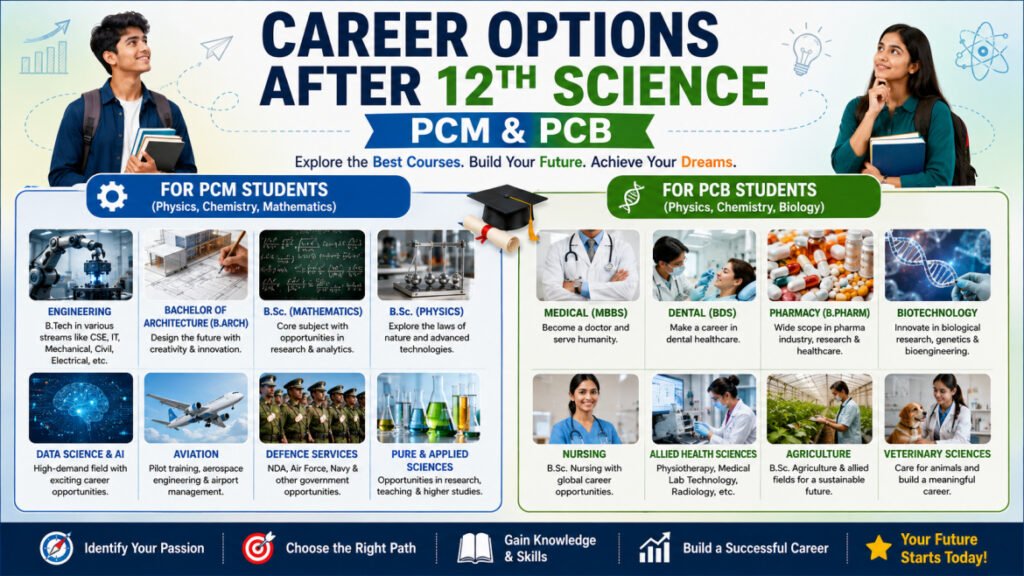
Science students have access to one of the widest ranges of professional courses available in India. Depending on whether a student studied Physics, Chemistry, Mathematics (PCM) or Physics, Chemistry, Biology (PCB), several rewarding career options are available.
Below are some of the most popular choices.
Engineering
Engineering remains one of India’s most sought-after career paths for PCM students. Engineers solve real-world problems by applying scientific and mathematical principles to design, build, and improve products, systems, and infrastructure.
Eligibility
- 10+2 with Physics, Chemistry, and Mathematics
- Entrance examinations such as JEE Main, JEE Advanced, or relevant state-level entrance tests (requirements vary by institution)
Popular Engineering Branches
- Computer Science Engineering
- Artificial Intelligence
- Data Science
- Mechanical Engineering
- Civil Engineering
- Electrical Engineering
- Electronics and Communication Engineering
- Chemical Engineering
- Aerospace Engineering
- Robotics Engineering
- Biomedical Engineering
Skills Required
- Analytical thinking
- Mathematics proficiency
- Problem-solving ability
- Creativity
- Teamwork
- Communication skills
Career Opportunities
Graduates may work as:
- Software Engineer
- Data Engineer
- Mechanical Engineer
- Civil Engineer
- AI Engineer
- Robotics Engineer
- Design Engineer
- Project Manager
- Research Scientist
- Entrepreneur
Average Salary
- Freshers: ₹4–10 LPA
- Experienced professionals: ₹10–40+ LPA depending on specialization, employer, and skills.
Medical (MBBS)
Medicine is one of the most respected and rewarding professions. Doctors diagnose diseases, treat patients, perform surgeries, and improve public health.
Eligibility
- Physics, Chemistry, Biology
- Qualifying score in the National Eligibility cum Entrance Test (NEET-UG), as applicable
Course Duration
- 5.5 years (including internship)
Skills Required
- Compassion
- Decision-making
- Patience
- Scientific knowledge
- Clinical skills
Career Opportunities
- General Physician
- Surgeon
- Pediatrician
- Cardiologist
- Neurologist
- Dermatologist
- Medical Officer
- Medical Researcher
- Public Health Specialist
Average Salary
- ₹8–15 LPA for entry-level roles, with significantly higher earnings after specialization and experience.
Pharmacy
Pharmacy combines healthcare, medicine, chemistry, and technology. Pharmacists ensure the safe, effective, and rational use of medicines while contributing to drug discovery, manufacturing, quality assurance, regulatory affairs, and patient care.
With the rapid expansion of India’s pharmaceutical industry, pharmacy has become one of the most promising healthcare careers after 12th Science.
Eligibility
- Physics, Chemistry, Biology or Mathematics (depending on program and institution)
- Admission may be merit-based or through entrance examinations, depending on the college
Popular Pharmacy Courses
- Diploma in Pharmacy (D.Pharm)
- Bachelor of Pharmacy (B.Pharm)
- Pharm.D
- Integrated pharmacy programs (offered by select institutions)
Skills Required
- Attention to detail
- Chemistry knowledge
- Communication skills
- Ethical practice
- Patient counseling
- Analytical thinking
Career Opportunities
- Registered Pharmacist
- Production Executive
- Quality Control Analyst
- Quality Assurance Officer
- Regulatory Affairs Associate
- Pharmacovigilance Executive
- Clinical Research Associate
- Medical Writer
- Drug Safety Associate
- Pharmaceutical Sales & Marketing
- Research Scientist
- Entrepreneur (Retail or Wholesale Pharmacy)
Average Salary
- Freshers: ₹3–8 LPA
- Experienced professionals and specialists can earn substantially more depending on their role, qualifications, and organization.
Why Choose Pharmacy?
India is among the world’s largest producers of generic medicines, and the pharmaceutical sector continues to expand globally. Pharmacy graduates can build careers in hospitals, pharmaceutical manufacturing, clinical research organizations, regulatory agencies, academia, and startups. The field also offers opportunities for higher studies, research, and entrepreneurship.
Nursing
Nursing is an essential pillar of healthcare. Nurses play a vital role in patient care, disease prevention, rehabilitation, and health education.
Eligibility
- Physics, Chemistry, Biology
- Admission criteria vary across institutions and states
Popular Nursing Programs
- B.Sc Nursing
- Post Basic B.Sc Nursing
- General Nursing and Midwifery (GNM)
- Auxiliary Nurse Midwife (ANM)
Career Opportunities
- Staff Nurse
- ICU Nurse
- Community Health Nurse
- Nurse Educator
- Operation Theatre Nurse
- Emergency Care Nurse
- Nursing Administrator
Average Salary
- ₹3–7 LPA initially, with higher earning potential through specialization, overseas opportunities, and advanced qualifications.
Biotechnology
Biotechnology is an interdisciplinary field that combines Biology, Chemistry, Genetics, Microbiology, and Technology to develop innovative solutions for healthcare, agriculture, food production, and environmental sustainability.
The demand for biotechnology professionals is increasing due to advancements in genetic engineering, vaccine development, precision medicine, and industrial biotechnology.
Eligibility
- Physics, Chemistry, Biology or Mathematics (depending on the program)
Major Subjects
- Molecular Biology
- Genetics
- Biochemistry
- Microbiology
- Immunology
- Bioinformatics
- Genetic Engineering
- Cell Biology
Career Opportunities
- Biotechnologist
- Research Associate
- Quality Analyst
- Clinical Research Professional
- Bioinformatics Analyst
- Pharmaceutical Scientist
- Food Technologist
- Agricultural Biotechnologist
- Laboratory Scientist
Average Salary
- ₹4–8 LPA for fresh graduates, with strong growth prospects in research organizations, pharmaceutical companies, biotechnology firms, and higher education.
Conclusion
Choosing the right course after Class 12 is one of the most important decisions in a student’s life. Science students have access to a wide range of rewarding career paths, from Engineering and Medicine to Pharmacy, Nursing, and Biotechnology. Each field offers unique opportunities, challenges, and growth potential.
Rather than following trends or external pressure, students should evaluate their interests, strengths, financial considerations, and long-term career goals before making a decision. A well-informed choice today can pave the way for a fulfilling and successful professional future.
In the next part of this guide, we will explore career options after 12th for Commerce and Arts students, along with emerging professional programs, diploma courses, and new-age career opportunities that are shaping the future workforce.
Best Courses After 12th Commerce
Commerce is one of the most versatile streams, opening doors to careers in accounting, finance, banking, management, taxation, business analytics, insurance, investment, entrepreneurship, and corporate leadership.
Students who enjoy working with numbers, economics, business concepts, and financial planning often find Commerce to be an excellent choice.
Bachelor of Commerce (B.Com)
B.Com is one of the most popular undergraduate programs in India and provides a strong foundation in accounting, finance, economics, taxation, business law, and management.
Eligibility
- Passed 10+2 from a recognized board.
- Admission criteria vary by institution.
Duration
- 3 Years
Major Subjects
- Financial Accounting
- Cost Accounting
- Corporate Accounting
- Economics
- Income Tax
- Business Statistics
- Banking
- Auditing
- Business Law
Career Opportunities
- Accountant
- Financial Analyst
- Tax Consultant
- Auditor
- Banking Professional
- Investment Executive
- Finance Manager
- Business Analyst
Average Salary
₹3–8 LPA (higher with certifications and experience).
Bachelor of Business Administration (BBA)
BBA prepares students for careers in business management, entrepreneurship, marketing, finance, human resources, and operations.
Specializations
- Marketing
- Finance
- Human Resource Management
- International Business
- Business Analytics
- Digital Marketing
Career Opportunities
- Business Executive
- Marketing Manager
- HR Executive
- Sales Manager
- Operations Manager
- Entrepreneur
Higher Studies
- MBA
- PGDM
- International Management Programs
Chartered Accountancy (CA)
Chartered Accountancy is among the most prestigious professional qualifications in finance and accounting.
Skills Required
- Analytical Thinking
- Numerical Ability
- Taxation Knowledge
- Auditing Skills
- Financial Planning
Career Opportunities
- Chartered Accountant
- Auditor
- Tax Consultant
- Financial Advisor
- CFO
- Independent Practitioner
Salary
Professionals can earn attractive salaries depending on experience, industry, and specialization.
Company Secretary (CS)
Company Secretaries ensure legal and regulatory compliance for organizations.
Career Roles
- Compliance Officer
- Corporate Advisor
- Legal Consultant
- Governance Professional
Cost and Management Accounting (CMA)
CMA professionals specialize in cost control, budgeting, financial planning, and strategic management.
Career Opportunities
- Cost Accountant
- Financial Controller
- Budget Analyst
- Management Consultant
Bachelor of Economics (B.A./B.Sc. Economics)
Economics graduates analyze markets, policies, consumer behavior, and economic trends.
Career Options
- Economist
- Data Analyst
- Policy Researcher
- Banking Professional
- Financial Consultant
Banking and Finance Courses
Students interested in banking can pursue specialized undergraduate programs or professional certifications.
Popular career options include:
- Bank Officer
- Loan Officer
- Investment Banker
- Financial Planner
- Credit Analyst
- Insurance Advisor
Best Courses After 12th Arts & Humanities
The Arts stream has evolved significantly over the years. Today, graduates build successful careers in law, journalism, psychology, design, civil services, public administration, literature, education, social work, and international relations.
Bachelor of Arts (BA)
BA provides students with flexibility to choose from multiple subjects.
Popular Specializations:
- English
- Political Science
- History
- Sociology
- Psychology
- Economics
- Geography
- Philosophy
- Public Administration
Career Opportunities
- Teacher
- Content Writer
- Civil Servant
- Journalist
- Researcher
- Social Worker
- NGO Professional
Bachelor of Journalism and Mass Communication (BJMC)
Media continues to expand rapidly through television, digital platforms, podcasts, newspapers, and social media.
Subjects
- Journalism
- Public Relations
- Media Ethics
- Digital Communication
- Video Production
- Advertising
Career Options
- Journalist
- News Anchor
- Content Creator
- Public Relations Officer
- Media Planner
- Digital Content Strategist
Bachelor of Fine Arts (BFA)
Ideal for creative students interested in visual arts and design.
Specializations include:
- Painting
- Sculpture
- Applied Arts
- Graphic Design
- Photography
Career Opportunities:
- Graphic Designer
- Illustrator
- Animator
- Art Director
- Creative Consultant
Bachelor of Design (B.Des)
Design is among the fastest-growing industries globally.
Popular Specializations
- Fashion Design
- Interior Design
- Product Design
- UI/UX Design
- Industrial Design
- Communication Design
Career Roles
- UX Designer
- Product Designer
- Fashion Designer
- Interior Designer
- Creative Director
Bachelor of Laws (Integrated Law Programs)
Students can pursue integrated law degrees such as:
- BA LLB
- BBA LLB
- B.Com LLB
Career Opportunities
- Advocate
- Corporate Lawyer
- Legal Advisor
- Judicial Services
- Legal Consultant
Psychology
Psychology has become increasingly important due to growing awareness of mental health and organizational well-being.
Career Options
- Clinical Psychologist (with higher qualifications)
- Counselor
- HR Specialist
- Child Psychologist
- Educational Counselor
Computer & IT Courses After 12th
Technology has become an integral part of nearly every industry. Students from Science, Commerce, and even Arts backgrounds can pursue many Computer & IT programs depending on the institution’s eligibility criteria.
Bachelor of Computer Applications (BCA)
BCA focuses on software development, programming, networking, cloud computing, and databases.
Major Subjects
- Programming Languages
- Database Management
- Data Structures
- Web Development
- Networking
- Software Engineering
Career Opportunities
- Software Developer
- Web Developer
- App Developer
- Database Administrator
- System Analyst
- Technical Support Engineer
B.Sc Computer Science
Students learn:
- Programming
- Artificial Intelligence
- Machine Learning
- Data Analytics
- Operating Systems
- Computer Networks
Career Opportunities
- Software Engineer
- Data Analyst
- Cybersecurity Professional
- AI Engineer
- Research Assistant
Information Technology (IT)
IT graduates support organizations by managing technology infrastructure and digital systems.
Career Options
- Network Engineer
- Cloud Administrator
- Cybersecurity Analyst
- Database Administrator
- IT Consultant
Data Science Programs
Data Science has emerged as one of the highest-paying career domains.
Students learn:
- Python
- Statistics
- Machine Learning
- Artificial Intelligence
- Data Visualization
- SQL
Career Roles
- Data Scientist
- Business Analyst
- Machine Learning Engineer
- Data Engineer
Cybersecurity
Cybersecurity professionals protect digital systems against cyber threats.
Career Opportunities
- Ethical Hacker
- Security Analyst
- Cyber Forensics Expert
- Security Consultant
Web Development
Web developers create websites and web applications.
Technologies include:
- HTML
- CSS
- JavaScript
- React
- PHP
- Python
- Node.js
Digital Marketing
Digital marketing has become one of the fastest-growing industries.
Career Roles
- SEO Specialist
- PPC Expert
- Content Marketer
- Social Media Manager
- Email Marketing Executive
- Affiliate Marketer
Students can begin freelancing or working with startups soon after acquiring practical skills.
Diploma and Certification Courses After 12th
Not every student wishes to pursue a traditional degree. Diploma and certification programs provide skill-oriented education with shorter durations and faster entry into the workforce.
Popular Diploma Courses
- Diploma in Pharmacy (D.Pharm)
- Diploma in Computer Applications
- Diploma in Hotel Management
- Diploma in Fashion Designing
- Diploma in Interior Design
- Diploma in Animation
- Diploma in Graphic Designing
- Diploma in Digital Marketing
- Diploma in Medical Laboratory Technology (DMLT)
- Diploma in Radiology
- Diploma in Nursing
- Diploma in Agriculture
Advantages
- Lower cost
- Shorter duration
- Industry-focused curriculum
- Practical training
- Faster employment opportunities
Popular Certification Courses
Students can strengthen their resumes through certifications in:
- Microsoft Office
- Python Programming
- Artificial Intelligence
- Data Analytics
- Graphic Designing
- UI/UX
- Web Development
- Cloud Computing
- Ethical Hacking
- Digital Marketing
- Tally
- GST
- Financial Modeling
These certifications often complement degree programs and improve employability.
Government Job Preparation After 12th
Government jobs remain a preferred career option for many students due to job security, stable income, pension benefits (where applicable), and opportunities for career progression.
Students can begin preparing immediately after Class 12 while pursuing higher education.
Popular Government Exams After 12th
- SSC CHSL
- SSC MTS
- Railway Recruitment Board (RRB)
- Indian Army Recruitment
- Indian Navy Recruitment
- Indian Air Force Recruitment
- State Police Recruitment
- Forest Guard Recruitment
- Postal Department Recruitment
Eligibility criteria and selection processes vary depending on the recruiting organization and position.
Higher Education with Government Exam Preparation
Many students pursue graduation while preparing for competitive examinations such as:
- Civil Services
- Banking Exams
- State Public Service Commission (PSC) Exams
- Insurance Sector Recruitment
- Teaching Eligibility Tests
This approach allows students to build academic qualifications while preparing for long-term career goals.
Essential Skills for Competitive Exams
Successful candidates generally focus on:
- Quantitative Aptitude
- Logical Reasoning
- English Language
- General Knowledge
- Current Affairs
- Computer Awareness
- Time Management
Developing a disciplined study routine and solving previous years’ question papers can significantly improve performance.
Tips for Choosing the Right Course
Before making your final decision, consider the following:
- Choose a course that aligns with your interests and strengths.
- Research future job demand and industry growth.
- Compare college infrastructure, faculty, and placement records.
- Evaluate tuition fees, scholarships, and return on investment.
- Seek guidance from teachers, mentors, career counselors, and professionals.
- Avoid selecting a course solely based on peer pressure or short-term trends.
- Consider opportunities for internships, certifications, and higher studies.
- Stay informed about emerging technologies and evolving career opportunities.
Emerging Career Opportunities After 12th – Future-Proof Careers for the Next Generation
The world of work is changing faster than ever before. Advances in technology, automation, artificial intelligence, globalization, and digital transformation are reshaping industries across the globe. Many careers that are in high demand today did not exist a decade ago, while several traditional jobs are evolving rapidly.
For students completing Class 12 in 2026, this transformation presents exciting opportunities. Alongside conventional professions like engineering, medicine, and commerce, a wide range of emerging careers now offer excellent salaries, international exposure, flexible work environments, and entrepreneurial potential.
Whether you dream of building intelligent software, creating digital content, designing products, managing hotels, flying aircraft, transforming agriculture, practicing law, becoming an educator, or launching your own business, there is a career path that aligns with your interests and ambitions.
This section explores some of the fastest-growing career fields after 12th and explains the courses, skills, career opportunities, and future prospects associated with each.
Artificial Intelligence (AI)
Artificial Intelligence is one of the most transformative technologies of the modern era. AI enables computers to learn, reason, recognize patterns, make decisions, and automate complex tasks. It is now widely used in healthcare, finance, education, manufacturing, transportation, e-commerce, entertainment, and scientific research.
As organizations increasingly adopt AI-powered solutions, the demand for skilled professionals continues to grow.
Eligibility
Students with a background in Science (especially PCM) are well suited for AI-focused undergraduate programs. However, many universities also offer interdisciplinary pathways that combine programming, mathematics, and data science.
Core Subjects
- Programming (Python, Java, C++)
- Artificial Intelligence Fundamentals
- Machine Learning
- Deep Learning
- Natural Language Processing
- Computer Vision
- Robotics
- Cloud Computing
- Data Structures and Algorithms
Essential Skills
- Logical reasoning
- Mathematical aptitude
- Programming
- Problem-solving
- Analytical thinking
- Continuous learning
Career Opportunities
- AI Engineer
- Machine Learning Engineer
- AI Research Associate
- Computer Vision Engineer
- NLP Specialist
- Robotics Engineer
- AI Product Manager
- AI Consultant
Future Scope
Artificial Intelligence is expected to revolutionize nearly every industry over the coming decade, making it one of the most promising long-term career choices for students interested in technology and innovation.
Data Science
Data has become one of the world’s most valuable resources. Organizations collect massive volumes of information to understand customer behavior, improve operations, predict trends, and support strategic decisions.
Data Science combines mathematics, statistics, programming, and business intelligence to extract meaningful insights from data.
Subjects Covered
- Statistics
- Python Programming
- SQL
- Machine Learning
- Data Visualization
- Big Data Technologies
- Predictive Analytics
- Business Intelligence
Career Opportunities
- Data Scientist
- Data Analyst
- Business Analyst
- Machine Learning Engineer
- Data Engineer
- Analytics Consultant
Skills Required
- Statistics
- Programming
- Critical thinking
- Communication
- Data visualization
- Problem-solving
Why Choose Data Science?
Data Science professionals are in demand across healthcare, banking, e-commerce, pharmaceuticals, government agencies, telecommunications, manufacturing, and consulting firms. The field offers strong career growth, competitive salaries, and opportunities to work on impactful projects.
Cybersecurity
As businesses, governments, and individuals increasingly rely on digital systems, protecting information has become a global priority. Cybersecurity professionals safeguard networks, applications, and data against cyber threats.
Core Topics
- Ethical Hacking
- Information Security
- Network Security
- Cryptography
- Digital Forensics
- Cloud Security
- Cyber Laws
- Incident Response
Career Roles
- Cybersecurity Analyst
- Ethical Hacker
- Security Consultant
- Penetration Tester
- Digital Forensics Expert
- Information Security Officer
Skills Required
- Networking
- Linux
- Programming
- Risk Assessment
- Problem-solving
- Attention to detail
Future Scope
With cyberattacks becoming more sophisticated, cybersecurity experts are increasingly sought after in both the public and private sectors.
Digital Marketing
Digital Marketing has transformed the way businesses connect with customers. Companies now rely heavily on websites, search engines, social media, email campaigns, and online advertising to build their brands and generate revenue.
This field offers excellent opportunities for creative and analytical students alike.
Key Areas
- Search Engine Optimization (SEO)
- Search Engine Marketing (SEM)
- Content Marketing
- Social Media Marketing
- Email Marketing
- Affiliate Marketing
- Influencer Marketing
- Web Analytics
Skills Required
- Creativity
- Communication
- Writing
- Marketing Strategy
- Analytics
- Problem-solving
Career Opportunities
- SEO Specialist
- Digital Marketing Executive
- Content Strategist
- Social Media Manager
- Performance Marketing Specialist
- Brand Manager
- Marketing Consultant
Why Choose Digital Marketing?
Digital Marketing allows students to work in agencies, startups, multinational companies, or as freelancers. It also provides a strong foundation for entrepreneurship and personal branding.
Design & Animation
Creative industries have expanded rapidly due to the growth of digital media, gaming, advertising, entertainment, and e-learning. Students with artistic abilities and a passion for design can build rewarding careers in this domain.
Popular Specializations
- Graphic Design
- UI/UX Design
- Motion Graphics
- Animation
- Visual Effects (VFX)
- Game Design
- Product Design
- Fashion Design
- Interior Design
Career Opportunities
- Graphic Designer
- Animator
- UI/UX Designer
- Art Director
- Creative Director
- Product Designer
- Game Artist
- Multimedia Specialist
Essential Skills
- Creativity
- Design Thinking
- Visual Communication
- Software Proficiency
- Collaboration
- Attention to Detail
Industry Demand
Design professionals contribute to industries such as advertising, film production, gaming, software development, publishing, education, and e-commerce.
Aviation
The aviation industry offers dynamic career opportunities for students interested in travel, technology, customer service, and aircraft operations.
Popular Courses
- Commercial Pilot Training
- Aircraft Maintenance Engineering
- Aviation Management
- Cabin Crew Training
- Airport Operations
Career Opportunities
- Commercial Pilot
- Cabin Crew Member
- Airport Manager
- Flight Dispatcher
- Air Traffic Services Professional
- Ground Operations Executive
Skills Required
- Communication
- Decision-making
- Leadership
- Technical Knowledge
- Customer Service
Future Scope
The continued growth of domestic and international air travel is creating demand for skilled aviation professionals across multiple roles.
Hospitality & Hotel Management
Hospitality is one of the world’s largest service industries, encompassing hotels, restaurants, tourism, event management, cruise lines, and luxury services.
Students who enjoy interacting with people and delivering exceptional customer experiences often find this field highly rewarding.
Popular Courses
- Bachelor of Hotel Management (BHM)
- Bachelor in Hospitality Management
- Diploma in Hotel Management
- Culinary Arts Programs
- Tourism Management
Career Opportunities
- Hotel Manager
- Restaurant Manager
- Event Manager
- Chef
- Front Office Manager
- Food and Beverage Manager
- Tourism Executive
Skills Required
- Communication
- Leadership
- Customer Service
- Time Management
- Teamwork
Future Scope
The hospitality sector continues to expand with the growth of tourism, business travel, and international events, offering opportunities both in India and abroad.
Agriculture and Agribusiness
Modern agriculture is driven by technology, sustainability, biotechnology, and innovation. Students interested in farming, food production, environmental conservation, and rural development can pursue careers in agricultural sciences.
Popular Courses
- B.Sc Agriculture
- Agricultural Engineering
- Horticulture
- Forestry
- Agribusiness Management
- Food Technology
Career Opportunities
- Agricultural Officer
- Agronomist
- Food Scientist
- Farm Manager
- Agribusiness Consultant
- Agricultural Researcher
Emerging Trends
- Precision Farming
- Smart Irrigation
- Drone Technology
- Organic Farming
- Agricultural Biotechnology
- Sustainable Agriculture
Law
Law remains one of the most respected professions and offers opportunities in litigation, corporate advisory, public policy, intellectual property, and judiciary.
Popular Integrated Programs
- BA LLB
- BBA LLB
- B.Com LLB
Career Opportunities
- Advocate
- Corporate Lawyer
- Legal Advisor
- Public Prosecutor
- Legal Consultant
- Judicial Officer
- Compliance Manager
Skills Required
- Logical Reasoning
- Communication
- Research
- Negotiation
- Analytical Thinking
Future Scope
The expansion of corporate governance, technology law, environmental law, and intellectual property rights continues to create new opportunities for legal professionals.
Education and Teaching
Education remains one of the most impactful professions, shaping future generations and contributing to societal development.
Students passionate about learning and mentoring can pursue careers in teaching, educational technology, curriculum development, and academic administration.
Popular Courses
- BA/B.Sc/B.Com + B.Ed
- Integrated B.Ed Programs
- Early Childhood Education
- Special Education
Career Opportunities
- School Teacher
- Lecturer
- Education Consultant
- Curriculum Designer
- Academic Coordinator
- Educational Content Developer
Emerging Opportunities
Technology has expanded career options in online education, educational content creation, learning management systems, and digital classrooms.
Entrepreneurship
Many students aspire to build their own businesses instead of pursuing traditional employment. Entrepreneurship encourages innovation, leadership, and problem-solving while creating employment opportunities for others.
Successful entrepreneurs identify market needs and develop products or services to address them.
Skills Required
- Leadership
- Creativity
- Financial Planning
- Marketing
- Communication
- Risk Management
- Decision-making
Popular Business Areas
- E-commerce
- Healthcare Startups
- Pharmaceutical Distribution
- Food Processing
- EdTech
- FinTech
- Artificial Intelligence Solutions
- Digital Marketing Agencies
- Software Development
- Agriculture Technology
Benefits of Entrepreneurship
- Financial Independence
- Flexible Career
- Unlimited Growth Potential
- Personal Satisfaction
- Innovation
- Job Creation
Challenges
Entrepreneurs should also be prepared to manage uncertainty, competition, financial risks, and continuous learning.
Building Future-Ready Skills
Regardless of the career you choose, employers increasingly value transferable skills that complement technical knowledge. Students should focus on developing:
- Communication skills
- Critical thinking
- Problem-solving ability
- Digital literacy
- Leadership
- Teamwork
- Emotional intelligence
- Adaptability
- Time management
- Financial literacy
Additionally, internships, online certifications, volunteer work, research projects, and participation in competitions can significantly enhance employability and practical experience.
Salary Comparison of Popular Courses After 12th
Salary varies depending on the course, institution, skills, location, employer, higher education, and work experience. The figures below represent approximate entry-level salary ranges in India.
| Course | Duration | Approximate Starting Salary (₹ LPA) | Career Growth |
|---|---|---|---|
| MBBS | 5.5 Years | 8–15 | Excellent |
| BDS | 5 Years | 4–8 | Very Good |
| B.Pharm | 4 Years | 3–8 | Excellent |
| Pharm.D | 6 Years | 5–10 | Excellent |
| D.Pharm | 2 Years | 2.5–5 | Good |
| B.Sc Nursing | 4 Years | 3–7 | Excellent |
| B.Tech | 4 Years | 4–12 | Excellent |
| BCA | 3 Years | 3–7 | Excellent |
| B.Sc Computer Science | 3 Years | 3–8 | Excellent |
| Data Science | 3–4 Years | 6–12 | Outstanding |
| Artificial Intelligence | 4 Years | 7–15 | Outstanding |
| Cybersecurity | 3–4 Years | 5–12 | Outstanding |
| Biotechnology | 3–4 Years | 4–8 | Very Good |
| BBA | 3 Years | 3–7 | Good |
| B.Com | 3 Years | 3–6 | Good |
| Chartered Accountancy (CA) | Varies | 8–25 | Excellent |
| Hotel Management | 3–4 Years | 3–6 | Good |
| Law (Integrated) | 5 Years | 5–12 | Excellent |
| Agriculture | 4 Years | 4–8 | Very Good |
| Digital Marketing | 3 Months–3 Years | 3–10 | Excellent |
| Animation & Design | 3–4 Years | 3–8 | Very Good |
Note: Salaries depend on individual performance, employer, location, and specialization. Graduates from premier institutions or those with advanced skills and internships may receive higher compensation.
Eligibility Criteria for Popular Courses
Understanding eligibility requirements helps students shortlist suitable programs based on their Class 12 subjects.
| Course | Eligibility |
| MBBS | Physics, Chemistry, Biology |
| BDS | Physics, Chemistry, Biology |
| BAMS | Physics, Chemistry, Biology |
| BHMS | Physics, Chemistry, Biology |
| B.Pharm | Physics, Chemistry, Biology/Mathematics (institution-specific) |
| D.Pharm | Physics, Chemistry, Biology/Mathematics |
| B.Tech | Physics, Chemistry, Mathematics |
| BCA | 10+2 (requirements vary by institution) |
| B.Sc Computer Science | Usually Mathematics preferred (institution-specific) |
| Biotechnology | Physics, Chemistry, Biology/Mathematics |
| Nursing | Physics, Chemistry, Biology |
| B.Com | Any Stream |
| BBA | Any Stream |
| BA | Any Stream |
| Law (Integrated) | Any Stream |
| Hotel Management | Any Stream |
| Agriculture | Usually Science (institution-specific) |
| Design Courses | Any Stream |
| Digital Marketing | Any Stream |
Admission Process After 12th
Although admission procedures differ among institutions, most follow a similar process.
Step 1: Choose Your Career
Identify your interests, strengths, and long-term goals before selecting a course.
Step 2: Shortlist Colleges
Compare colleges based on:
- Accreditation
- Faculty
- Infrastructure
- Laboratories
- Placements
- Fees
- Scholarships
- Internship opportunities
Step 3: Check Eligibility
Review:
- Minimum percentage
- Subject requirements
- Entrance examination criteria
- Age limits (where applicable)
Step 4: Apply Online
Most colleges provide online application portals where students can submit:
- Personal details
- Academic records
- Identity documents
- Photographs
- Application fees
Step 5: Entrance Examination (if applicable)
Many professional programs require qualifying entrance examinations before admission.
Step 6: Counseling Process
Qualified students participate in centralized or institutional counseling, where seats are allotted based on merit, entrance scores, reservation policies, and preferences.
Step 7: Document Verification
Commonly required documents include:
- Class 10 Marksheet
- Class 12 Marksheet
- Transfer Certificate
- Migration Certificate (if applicable)
- Character Certificate
- Passport-size Photographs
- Government-issued Identity Proof
- Category Certificate (if applicable)
- Income Certificate (for scholarship eligibility)
Step 8: Fee Payment and Enrollment
After verification, students complete fee payment and confirm admission.
Major Entrance Exams After 12th
Different courses require different entrance examinations.
| Entrance Examination | Primary Courses |
| JEE Main | Engineering |
| JEE Advanced | IIT Engineering |
| NEET-UG | MBBS, BDS, BAMS, BHMS, Nursing (as applicable), Allied Health (institution-specific) |
| CUET-UG | Undergraduate Programs in Participating Universities |
| CLAT | Integrated Law |
| NIFT Entrance Exam | Fashion Design |
| NID Entrance Exam | Design |
| NCHM JEE | Hotel Management |
| ICAR Entrance | Agriculture Programs (as applicable) |
| State CETs | Engineering, Pharmacy, Agriculture, Management, and other programs (state-specific) |
Always verify the latest eligibility, syllabus, and application schedule from the official conducting authorities.
Top Colleges in India
Choosing the right institution is as important as selecting the right course.
Engineering
- Indian Institutes of Technology (IITs)
- National Institutes of Technology (NITs)
- IIITs
- BITS Pilani
- VIT
Medical
- AIIMS
- Christian Medical College (CMC)
- Maulana Azad Medical College
- King George’s Medical University
- JIPMER
Pharmacy
- National Institute of Pharmaceutical Education and Research (NIPER)
- Jamia Hamdard
- Manipal College of Pharmaceutical Sciences
- JSS College of Pharmacy
- Bombay College of Pharmacy
Management
- Shaheed Sukhdev College of Business Studies
- NMIMS
- Christ University
- Symbiosis
Law
- National Law Universities (NLUs)
- Faculty of Law, University of Delhi
- Symbiosis Law School
Agriculture
- ICAR-affiliated Agricultural Universities
- Punjab Agricultural University
- GB Pant University of Agriculture and Technology
Design
- National Institute of Design (NID)
- National Institute of Fashion Technology (NIFT)
- MIT Institute of Design
Scholarships for Students
Financial assistance allows deserving students to pursue higher education without excessive financial burden.
Government Scholarships
Students may explore:
- Central Sector Scholarship Scheme
- National Scholarship Portal (NSP)
- Post-Matric Scholarships
- State Government Scholarship Programs
- Minority Scholarships (where applicable)
Institution-Based Scholarships
Many universities offer:
- Merit Scholarships
- Sports Scholarships
- Need-Based Financial Aid
- Scholarships for Outstanding Academic Performance
- Scholarships for Girls (institution-specific)
Private Scholarships
Several foundations, trusts, and corporate organizations provide scholarships based on academic merit, financial need, or specific fields of study.
Students should regularly check eligibility criteria, application deadlines, and required documents.
Final Career Guidance
Selecting the right course after Class 12 is a personal decision that should reflect your interests, abilities, aspirations, and circumstances. Rather than following trends or external pressure, invest time in understanding yourself and researching available opportunities.
Keep these principles in mind:
- Choose a course you genuinely enjoy.
- Research future industry demand.
- Compare colleges carefully.
- Build practical skills alongside academics.
- Complete internships and projects.
- Improve communication and digital skills.
- Stay updated with emerging technologies.
- Pursue lifelong learning through certifications and higher education.
Success is not determined by a course alone but by your commitment, discipline, adaptability, and willingness to keep learning.
Conclusion
The journey after Class 12 is filled with possibilities. Whether you aspire to become a doctor, engineer, pharmacist, lawyer, entrepreneur, data scientist, teacher, designer, or civil servant, there is a pathway that can help you achieve your goals.
This comprehensive guide has explored traditional and emerging career options, eligibility requirements, admission processes, entrance examinations, salary expectations, scholarships, and practical career planning advice. By choosing a course aligned with your interests and continuously developing your skills, you can build a rewarding and future-ready career.
Remember that careers evolve, industries change, and new opportunities emerge every year. Stay curious, remain adaptable, and never stop learning. Your decisions today can shape a successful and fulfilling tomorrow.
Frequently Asked Questions (FAQs)
1. Which course is best after 12th?
The best course depends on your interests, strengths, career goals, and preferred field of study.
2. Which course offers the highest salary?
Medicine, Artificial Intelligence, Data Science, Engineering, Chartered Accountancy, and Law often provide strong earning potential.
3. Is Pharmacy a good career in 2026?
Yes. Pharmacy offers opportunities in healthcare, research, manufacturing, quality assurance, regulatory affairs, clinical research, and entrepreneurship.
4. Can Commerce students pursue IT careers?
Yes. Courses such as BCA, Digital Marketing, Data Analytics, and various technology certifications are available to Commerce students, subject to institutional eligibility.
5. Can Arts students become successful?
Absolutely. Arts graduates excel in law, civil services, journalism, education, design, psychology, public administration, and many other fields.
6. Is BCA better than B.Tech?
Both are valuable. The better option depends on your career goals, interests, and academic background.
7. Which course has the best future scope?
Artificial Intelligence, Data Science, Cybersecurity, Healthcare, Biotechnology, Renewable Energy, and Digital Technologies are among the fastest-growing sectors.
8. How important are internships?
Internships provide practical experience, industry exposure, networking opportunities, and improve employability.
9. Should I choose a government or private college?
Choose the institution that offers quality education, experienced faculty, practical training, and strong placement support within your budget.
10. Can I change my career later?
Yes. Continuous learning, certifications, higher education, and transferable skills make career transitions possible.
11. What should I do if I am confused after Class 12?
Consult teachers, career counselors, mentors, and professionals while assessing your interests and strengths.
12. Are online certifications useful?
Yes. Reputed certifications can enhance your skills and complement your degree.
13. Is studying abroad a good option?
It can be beneficial depending on your financial resources, academic goals, and career plans.
14. What is the ideal age to begin career planning?
Students should begin exploring career options during Classes 10–12.
15. Which stream has the highest number of career options?
Science generally offers the widest range of academic pathways, though Commerce and Arts also provide diverse opportunities.
16. Can Biology students pursue Pharmacy?
Yes, Biology students are eligible for Pharmacy programs, subject to institutional requirements.
17. Is Mathematics compulsory for Computer Science?
Requirements vary by institution. Many programs prefer Mathematics, while others may have different eligibility criteria.
18. How can I improve my employability during college?
Focus on internships, certifications, communication skills, projects, and networking.
19. Are government jobs still a good career option?
Yes. Government careers continue to offer stability, structured progression, and opportunities to serve the public.
20. How important is communication skill?
Communication is one of the most valuable employability skills across all professions.
21. Can I pursue an MBA after graduation?
Yes. Graduates from various disciplines are eligible for MBA programs, subject to admission requirements.
22. Is entrepreneurship a good career after college?
Yes. Entrepreneurship is suitable for students interested in innovation, leadership, and building businesses.
23. Which course is best for international career opportunities?
Engineering, Medicine, Nursing, Pharmacy, Data Science, Cybersecurity, and Hospitality often provide global career prospects.
24. How important is higher education?
Higher education can improve specialization, research opportunities, and career advancement.
25. What is the key to long-term career success?
Continuous learning, adaptability, practical experience, professionalism, and ethical conduct.
References
The information presented in this article has been compiled and verified using official government portals, regulatory authorities, educational institutions, and recognized industry resources.
- All India Council for Technical Education (AICTE). (2026). Official Website. https://www.aicte-india.org/
- National Assessment and Accreditation Council (NAAC). (2026). Official Website. https://www.naac.gov.in/
- National Institutional Ranking Framework (NIRF). (2025). India Rankings. https://www.nirfindia.org/
- University Grants Commission (UGC). (2026). Official Website. https://www.ugc.gov.in/
- Ministry of Education, Government of India. (2026). Higher Education Resources. https://www.education.gov.in/
- National Testing Agency (NTA). (2026). Official Website. https://nta.ac.in/
- National Testing Agency. (2026). NEET (UG). https://neet.nta.nic.in/
- Joint Entrance Examination (JEE Main). (2026). Official Portal. https://jeemain.nta.nic.in/
- Common University Entrance Test (CUET-UG). (2026). Official Portal. https://cuet.nta.nic.in/
- Consortium of National Law Universities. (2026). Common Law Admission Test (CLAT). https://consortiumofnlus.ac.in/
- National Institute of Fashion Technology (NIFT). (2026). Admissions. https://www.nift.ac.in/
- National Institute of Design (NID). (2026). Admissions. https://www.nid.edu/
- National Council for Hotel Management & Catering Technology (NCHMCT). (2026). Official Website. https://www.nchm.gov.in/
- Indian Council of Agricultural Research (ICAR). (2026). Education Division. https://icar.org.in/
- Pharmacy Council of India (PCI). (2026). Official Website. https://www.pci.nic.in/
- National Medical Commission (NMC). (2026). Official Website. https://www.nmc.org.in/
- Indian Nursing Council (INC). (2026). Official Website. https://www.indiannursingcouncil.org/
- Bar Council of India (BCI). (2026). Legal Education. https://www.barcouncilofindia.org/
- National Scholarship Portal (NSP). (2026). Government Scholarships. https://scholarships.gov.in/
- Ministry of Skill Development and Entrepreneurship (MSDE). (2026). Skill India Mission. https://www.msde.gov.in/
- Skill India Digital. (2026). Official Portal. https://www.skillindiadigital.gov.in/
- Directorate General of Training (DGT). (2026). Vocational Education and Training. https://dgt.gov.in/
- National Career Service (NCS), Ministry of Labour & Employment. (2026). Career Guidance Portal. https://www.ncs.gov.in/
- National Skill Development Corporation (NSDC). (2026). Skill Development Programs. https://nsdcindia.org/
- Ministry of Electronics and Information Technology (MeitY). (2026). Digital India Initiatives. https://www.meity.gov.in/
- World Economic Forum. (2025). The Future of Jobs Report 2025. https://www.weforum.org/
- International Labour Organization (ILO). (2025). Employment Trends and Career Outlook. https://www.ilo.org/
- Organisation for Economic Co-operation and Development (OECD). (2025). Education at a Glance. https://www.oecd.org/education/
- UNESCO Institute for Statistics. (2025). Education Data. https://uis.unesco.org/
- World Health Organization (WHO). (2025). Health Workforce and Education Resources. https://www.who.int/
Image Credits
All illustrations, icons, diagrams, and visual representations used in this article are either:
- Original creations by the author,
- AI-generated for educational purposes, or
- Used under appropriate licensing where applicable.
Disclaimer
The information provided in this article is intended for educational and informational purposes only. Admission policies, eligibility criteria, entrance examinations, fee structures, scholarship schemes, and salary trends may change over time. Readers are advised to verify the latest information from the official websites of the respective universities, regulatory authorities, and examination bodies before making academic or career decisions.